Showing posts with label Temples. Show all posts

Monday, September 19, 2011

Medieval Times: Hampi Part 2

Sorry for this delayed post. I have been too busy at work & lack of internet at work also makes it difficult to keep up my blog. And there have been a lot of outings too. So continuing the journey through Hampi, next stop is at the two Ganesha idols called Kadale Ganesha and Savivekalu Ganesha. The names come from the look of the idol. The first Ganesha idol is monolithic. The shape of the ganesha looks like Bengal gram or channa dal. Kadale = Channa in Kannada. The idol is huge and enclosed inside a temple. The stomach of Ganesha has been cut on two sides by the attackers trying to remove it hoping to find gems under the statue. Again as this statue is broken, it is not worshipped.
Kadale Ganapati Temple
King Krishnadev Raya was one of the finest kings to rule Hampi. He loved art and literature. Most of the artifacts, temples were constructed under his rule. The Kadale Ganesha also has a stage with pillars and carvings on them which were constructed by him.
The second ganesha name comes from a mustard seed. Sasive = Mustard in Kannada. It is a smaller ganesha on the outside near the roads.
Kadale Ganapti
The next stop is to the famous Vitthala Temple. The department of archaeology have arranged battery driver carts to take people to the actual location – must be to avoid pollution around theruins. As we reach towards the gopuram of the temple we see two rows of stone stages – mantapa’s. These were the market yards in the medieval times. Merchants from the kingdom and from neighboring kingdoms would setup their markets and trade. Many of the stones have fallen off.
The gopuram of the temple is quite broken at the center..most of the art is also ruined. As we enter the temple it is MAGNIFICIENT! A huge area of stone temples, sanctums and the famous stone chariot. It is treat to the eye and a realization of the fine stone art of the 15th century! 
Vitthala Temple

Outside the Vitthala Temple - Market stalls
The main temple is a musical temple, Sangeet Mantapa. The temple is made up of hundreds of pillars which when played with finger tips produce sounds of different instruments like flute, table, veena etc. In the royal times, the musicians would wear sandalwood rings on their finger & play the music. Even today in complete silence the music can be heard up to 50kms distance! The temple has numerous carvings, mainly different avatars of Vishnu, depicting the mythological stories. The stone carvings are so fine; the guide showed us multiple pieces 2 in1, 3 in 1, 4 in 1 sculptures in parts from different animals. There was a piece which showed an elephant, a horse, and a monkey all in one at different angles!
Musical Temple
I have a picture of a piece that has a Bull and an elephant when seen from left and right respectively.
Left side is a Bull and right side is an Elephant
On the right of the Sangeet mantapa is the Bhajan mantapa used for recitals. Another magnificent sanctum built out of stone & carvings! On the left is the Bhojan mantapa for serving food for everyone. Behind is the mantapa for royal meetings and gatherings. 
The Stone pillar producing music of different instruments
In the center of the whole area is the stone chariot- one of the total three chariots in India. Other two are in Mahabalipuram and Konark. The stone seems to be monolithic but is not. The carvings are made perfectly to hide the creases of the stone blocks. Originally the chariot had 2 stone horses attached too but they were destroyed hence a pair of elephants is placed in front of them now. But the hoofs of the horses are still seen on the chariot front. In the royal times the stones wheels rotated and were moved around. But now they have been sealed to prevent visitors from damaging it. The chariot holds Garuda bird (mount of Lord Vishnu). 

Stone Chariot

Wednesday, August 17, 2011

Medieval Times: Hampi – Part 1

Day 2 was visit to Hampi. A small town on the banks of Tungabhadra River with ruins from the past. We started out early around 7am. Quick road side south Indian breakfast of idli, vada, paniyaram and coffee and 15 mins drive from Hospet into Hampi! The drive is beautiful with large boulders formations, green farmlands. Reaching the park outside the ruins, we were surrounded by guides. At start we didn’t opt for it because they cost 800/- ($18); later we came up with a plan of coupling with another group and sharing the priceJ. We eventually settled for 400/-
Virupaksha Temple Gopuram
Again I shall try to remember and share as much information as possible. Hampi belongs to times of 9th century, 13th century invasions! Hampi is the latest modern name; before which it had 4 other names in chronological order – Pampashketra, Kishikinda, Vidyanagara, Vijayanagara and Hampi. The Brits could not say the word Pampa so they re-arranged it to Hampi. Pampadevi is none other than Goddess Parvati. Kishikinda is the mythical place in Indian mythology which belonged to the monkey kingdom of Monkey king Sugriva, younger brother of Vali. Lord Rama had helped Sugriva along with Lord Hanuman to fight the elder brother Vali. It is believed that Lord Hanuman was born in the mountains of Hampi on the Anjaneya Parvat.
Fine carvings inside the temple
Hampi had a series of kings, invasions and wars of different kingdoms and dynasties. The most significant one is the Vijayanagara kingdom which spread to far distances of south to Ceylon and east to Orrisa. It was one of the most successful and golden era of Hampi when the Vijayanagara dynasty ruled. Hampi consists of numerous temples; around 500 temples exist out of which only 5-10 are worshipped today. Reason being, most temples are looted, some have broken statues. And in Hindu traditions, we do not worship a broken/chipped/cracked idol of god.
Paintings on the ceiling colored with vegetable colors in 7-9th century! Display of Draupadi's Swayamvar
The first stop in the tour is to the Virupaksha temple – Virupaksha is the form of Shiva. This temple dates back to 7th century even before the Vijayanagara kingdom ruled here.  The temple is still worshipped today; there is a self-created lingam inside the temple. Many decorative parts around the temple are destroyed by the attackers in the past. There are different areas inside the temple for kitchen, meetings etc. The meeting halls consist of 100’s of pillars. Four pillars together are called a mantapa. Inside the temple there is a mysterious scientific phenomenon -The main gopuram of the temple outside is huge and the art carvings are partly broken.  Inside the main temple there is wall with a 6” long crevice from which the light penetrates in and mysteriously the shadow of the main gopuram out on the street is inverted. There is no lens of any kind. We have been trying to figure it out all through our trip and still haven’t come with a solution!
Inverted shadow of the Virupaksha Gopuram inside the temple
Aperture from where the sunlight falls in to form the above inverted shadow
There is a real elephant inside the temple and we got to see a magnificent show of its worship to the gods. The elephant is so well trained that it stops by each of the temples and bends down to bow to the gods. For the main temple entrance the elephant bent down on both its front knees, then rose up and raised itself up in the air standing on its two rear feet & raised its trunk in the air. I did the “get blessings from the elephant” act for the first time. If you drop a coin in its trunk, it gives it to his master & while you bow to it, it touches its trunk on your head, of course its mild touch is like a THUD in my head..but it was so much fun!

Elephant blessings

3-headed Nandi
There is a unique 3-headed Nandi (bull) in the temple. The guide says it’s one of a kind in the world and if anybody asked you what you saw in Hampi and if you didn’t mention the 3-headed Nandi then you haven’t seen Hampi yet! Ha ha! Well I saw it, so I have definitely visited Hampi. Yes!!!!
Replacement Nandi's - Nanda, Sunanda and Mahananda are the names :)
One of the bull faces is chipped so it is not worshipped and hence there are 3 individual bulls installed to replace the original statue.

Chitradurga Fort

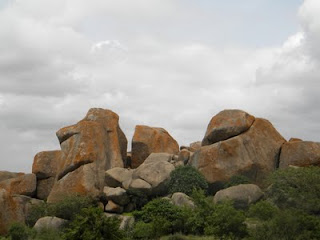
This long weekend was our first long road trip in India. The 3-day trip was planned to cover the Chitradurga fort in Chitradurga district, Tungabhadhra dam in Hospet, Hampi town of medieval ruins and Halebidu temple in Bidur city of Karnataka. We started off from electronic city at 6.30am and reached Chitradurga around 10.30am. Karnataka, if ever viewed before is unique for its mountains made of countless round boulders in different sizes, mostly huge! And the most mysterious thing is the way they are placed; makes all my science and laws of gravity go for a toss!
Snake carving at entrance
We hired a guide to get a good experience. So I am going to try and remember things the guide shared with us & put it out here. Chitradurga fort is the second largest fort in India, first being Genji fort in Tamilnadu.
Nandi, Shiva, Ganesha
The fort has 7 entrances; first one is “Rangana Bagalu.” through which we actually enter the fort premises. There are small houses and stores now; I believe they must have been the houses of the common people in the old times, like in the movie TROY the entrance to the kingdom start with a large door opening into the houses of the subjects then finally leading to the king’s castle! The second entrance was destroyed in the expansion of the city, govt. stuff. The third entrance Kamana Bagalu is the current entrance to the fort. The entrance wall has a 7-hooded snake carved on the rock. The walls are as high as 15 meters. The opposite side of the wall bears carvings of Ganesh, Shiva and Nandi indicating that they have to be worshiped first before entering the fort. The entrance is so designed that the enemy cannot just barge into the fort, it is serpentine in shape so the enemy horses have to pause and turn every few meters; the corridors are narrow so elephants cannot be used to attack either. The height of the walls gives an advantage to attack the enemy from the top. 
Landscape
The fourth entrance is called Vishadakatti Bagalu (Poisoned knife door). The fort was designed to kill maximum enemy soldiers from the start. At one of the entrances there used to be water flowing under the stairs to form a pond outside where poisonous snakes and crocodiles would be left to kill the enemy.
Vishdakatti Bagilu
The doors are small in width and thick hence difficult to break down with large columns. The walls were built such that huge squared rock slabs would be supported with mud on the inner side thus when they were hit with canons the mud behind the slabs would provide a shock absorbing effect and still keep the walls in tact! The unique thing about the fort is that there is no cementing material used to stick the huge slabs of rock. They are all just cut, trimmed and placed exactly over each other like a stack.
 
Gante Bagilu
There are numerous temples inside the fort compound. The fort encompasses large boulders all around. The guide said that the place is older than the times of the kings who made the fort. He showed us a rock with the Stone Age time carving of a deer. As we walked through we saw numerous caves, big carved out holes in the rocks to store oil. The temples have carvings of different gods like Ganesh, Hanuman, Ram-Laxman, dancing ladies etc.

Stone age carving of a deer
Then we headed through the rocky yet paved landscape. In the surrounding rocks there are rocks that look like animals in the jungle. The reason behind the name of the place is the scenery around - “Chitradurga” means picturesque; chitra = picture and durga = fort. There are rocks that look like a rabbit, elephants, frog and a boat. They all look like a picture hence the name. I managed to find a rock that looks like the lion king J 
Rabbit shapped Rock on the center left side
Frog shapped rock in the center
Sitting Elephant rock
(Left) Lion King face rock that I found :)
As we moved ahead we saw the commercial area of the king, a place where all the business took place like minting money as in gold silver coins, his ministry setting up business meetings etc. All of it is broken and look like ruins now. In the old times temples were made by loading up expensive gold gems under the ground and then the statue of the gods would be placed on the money. When the Mughals and Britishers attacked the fort, they uprooted all the idols to look for hidden treasures! Hence most temples now don’t have any idols. On the way we see two reservoirs. The fort has amazing rain harvesting and filtering setup. The two reservoirs are called Akka Tangi  (Elder sister-younger sister). Story goes as the king had two wives he had a reservoirs for each. When the king died, in those times Sati tradition being followed (where the widowed wife has to sacrifice her life after the husband’s death by jumping into fire pyre); each of the queens jumped in their reservoirs sacrificing their lives.
Pool for the king to play Holi festival
From the mythology there are two temples at the center of the area. It is believed that the mythical demon characters Hidimba and sister Hidimbi lived here. Bheema from Mahabharata epic married the demon Hidimbi. There is a Hidimbeshwar temple, very picturesque as it is elevated; it gives a great view of the whole place. There is a stepped pool built for the king and people to play Holi, the festival of colors and water!
Hidimbeshwara Temple
Obawa's cave on the left besides the steps
At the extreme top of the rocks we see huge cylinders. These would contain ghee (clarified butter) to store weapons and prevent them from rusting. Also men who could climb the smooth, greasy boulders to the top would be selected as the best soldiers!
Secret passage where Obawa killed invaders
Finally there is a famous story of a brave woman called Obawa. She was a wife to a simple watch guard in the kingdom. The fort has one secret entry from the back from where exactly one person can crawl in each time. When her husband was having lunch one day, Obawa was away to bring water for him, when she heard the whispers of the enemy creeping in. She with her presence of mind single –handedly killed many of the soldiers with a thick wooden rod called Onake in Kannada, used for beating paddy to break the rice corns. When her husband saw the bloody scene he came to help her and she asked him to go and alarm the army with his bugle while she manages the secret hole. She was rewarded for her bravery with the title of “Onake Obawa”.
Mighty walls of Chitradurga Fort
 The fort is built with so much intelligence and highest degree of architecture in those times, it is said that the Mughal ruler Hyder Ali attacked it 7 times to fail. He was successful only when one of the ministers betrayed the king and shared the secret entrances to the fort. Amazing day spent at the fort.

Tuesday, July 5, 2011

Akshardham - Gandhinagar

Day 2 in Baroda, we decided to go to Akshardham Temple in Gandhinagar. Being at home with parents we obviously started late. 6am was the plan for any trip, when we left it was 11am! We started off in our 5 seater Omni taking the express highway to Gandhi Nagar. It took us about 3hours at a good 90kmph speed on the highway. It was a good day with cloudy weather, however the weather was so humid, anytime we stopped the car; it felt like we were in the hot over air room again! Go go go…keep going don’t stop!


Beautiful carvings on sandstone

When we reached it was almost 2pm. We ate our home-packed lunch outside the temple premises in our car. Apparently, after the terrorist attacks inside the temple in 2002, the institution doesn’t allow any belongings inside the temple. Which means no camera, no mobile– hence no photos…at all L big disappointment!  But then it also means that the readers should really come visit this place! It is magnificent architecture.
The temple is build in the memory and to worship Lord Swaminarayan who is believed to be an avatar of Lord Narayana, during the period of 1781 – 1830. The majestic, intricately carved stone structure stands amid sprawling gardens. Six thousand tones of pink sandstone were used in building the monument which is regarded as an architectural masterpiece. The intricate carvings on the pillars, walls & the ceilings are simply outstanding. On entering the temple, we see a huge 7 feet high golden statue of Lord Swaminarayan.
On the 1st and 2nd floor of the monument are the museum that have preserved the belongings of Lord Swaminarayan such as clothes, bed spread, hats, his room replica, hair, bones and ashes from cremation and teeth and nail bits when he was alive. Devotees preserve these, believing they still hold his spirituality.
Coming out of the temple there are two other attractions;
  • Mystic India - the video presentations of his teachings and small clips of a movie of his biography.  Ticket Rs. 45 per head
  • A 45-minute laser water show depicts the story of Nachiketa from the Kathopanishad. The show, the longest of its kind, features the use of 4,000 nozzles, 2,000 lights, over 100 pumps and 12 fireball throwers. Ticket Rs. 75 per head.
Note: The temple is free for visiting.


Lord Swaminarayan
The water show was really splendid worth the ticket price. It displayed the story of a young boy Nachiketa and his dialogue with Lord Yamaraj – God of death; discussing the meaning of life, death, life after death.
Here is the official trailer video of the laser show.


A few personal disappointments! The Mystic India video was very beautiful showing Indian culture and people and celebrations. It actually made me feel like why I would ever leave my country which has such a rich ancient culture. We are good people with vast mysterious interesting history. Or living aboard will make me miss so many, actually infinite little things. The video mentioned the history of Indian spirituality which was quite interesting and I was totally hooked to the video. But as the video came to an end, people just stood up and started walking out, to the extent that I had to stand up and watch the last 5 mins of the show. It was sad in a way that my own people are not fascinated by the country’s history and magnificent culture. I wondered who is the target audience here then. I am neither too religious not spiritual, but to know of ancient Indian history was very interesting. Great day! This should be check on the Indian bucket list.

Monday, June 27, 2011

Talakad

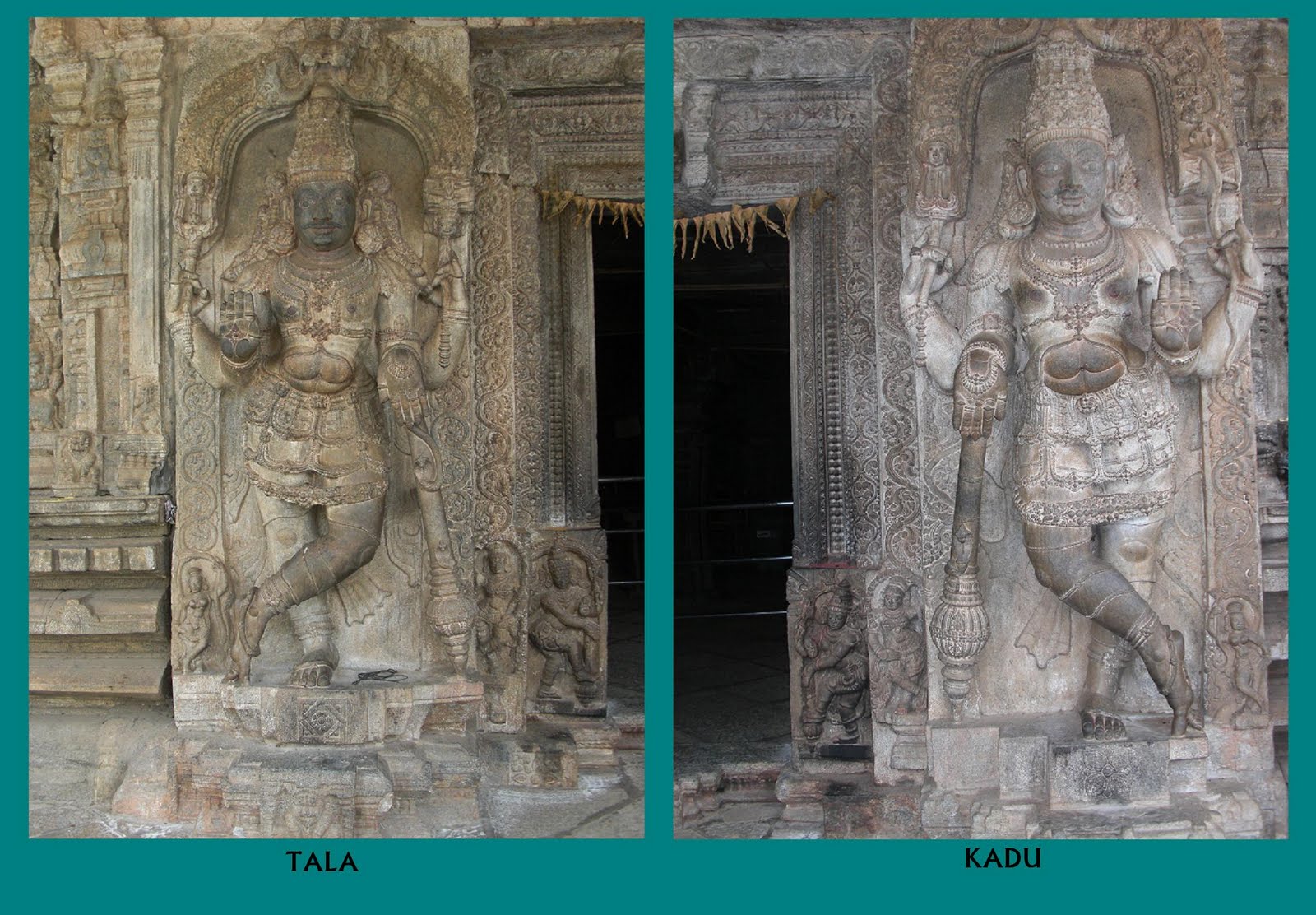
We drove to Talakad from Muthathi. The town is famous for ancient temples from the 16th century and before. We visited the famous Vaidhyeshwar Shiva temple. The temple looks really really amazing from the stone age times. There were bunch of guides eager to explain us the temple history but we were too late to return so we just walked through the temples and took some pictures for my blog. After I got home, I was curious about the temple because the guides were explaining something very interestingly. So, I googled Talakad! To start with I learnt that the town gets its name from two brothers Tala and Kadu, who were the ones that found the Lord Shiva Lingam with great effort due to which Lord Shiva had granted them immortality. The entrance of the temple holds the statues of the two brothers on each side.
Main Entrance on the right of this picture
As I searched more, I learnt there is a legendary history about this town, a curse that people even today believe and follow to ease the effects of it. The curse was spelled on the Royal family of Mysore – The Wodeyars. The story goes as – In the 16th Century Raja Wodeyar ruled Mysore and the Vijayanagar viceroy named Tirumala held court at Srirangapatna. Raja Wodeyar attacked Tirumala after knowing about the planned plot to kill him. Raja Wodeyar took over Srirangapatna and Tirumala fled to a village of Malangi with his wife, Rani Alamelamma.
Side entrance
The Rani/queen had taken all the royal jewelry along with her which Raja Wodeyar wanted to get back. So he sent his soldiers to seek the queen. The queen was taken by surprise when the soldier found her at the banks of Talkad. As the soldiers pursued her, she made a quick escape and jumped off a cliff into the River Cauvery. But before jumping she let out the curse –
Talakadu Maralaagali
Malangi Maduvaagali
Mysuru Dhoregalige Makkalagade hogali!
The literal translation would be –
I curse Talakad to be submerged under creeping sands
May a cruel whirlpool be a scourge of Malangi
And the kings of Mysore suffer the pangs of Childlessness!
And to ward off the ill-effects of the curse, devotees from Karnataka, Tamil Nadu and Kerala perform the Panchalinga darshan once every four to 14 years, to appease the five forms of Lord Shiva. Again the date for this darshan is a complex calculation. The first day should fall on a new moon day in the Hindu Kartika month. It should be a Monday and the sun sign should be Scorpio. Such a combination occurs every 4 to 14 years. The last darshan was in 2006 and the previous one in 1993.

Temples
 As dramatic as it sounds I went ahead asking my grandmother. First, to my surprise she knew the story, the people, their names, everything! I asked her if really the curse was true that the royal family has been childless and she said yes, for the past 20 generations they have had no children and hence they adopt heirs to the royal family. Today I wanted to study more about this curse. Of course there has to be a scientific explanation for the 3 layers of the curse – the sand burial of the temples, the whirlpool near the village of Malangi and the heir-less royal family of Mysore.
Lingams out in the open
I found a wonderful blog link and it was just as interesting as the legend itself. Read along J
Dravidian Architecture
Of course the superstitions we follow have some scientific background but the stories woven around them are so interesting they make me find more information about them. As I read the above blog, I had a mental picture running in my mind like a movie about the queen and the curse J. 
Temple carvings
 Of course there are other versions of the story too - http://www.openthemagazine.com/article/art-culture/the-legend-of-talkad
Carvings of Tala and Kadu at the entrance of the temple
Now I am eager to go back to the town of Talakad and look for other ancient temples for the sake of art and history.

Monday, June 20, 2011

Malleshwaram

Entrance to Nandi Theertha Temple
I have been busy for a while, and hence haven’t written much. Work wise I am free as a bird as we have some of our systems down lately; which is not at all fun! Personally, my mother visited me; I didn’t really take any vacation to spend time with her because I am still new at my work place. One day I went home early to go out with her. We went to Malleshwaram, a rich cultural part of Bangalore with many Hindu temples, schools and large Tamil Brahmin population; a place with great history!
There are numerous famous old temples in the area. We visited 3 of them which were right in front of each other, on the same street. Frankly we drove down to visit the new Tirupathi temple which is supposed to be equivalent to the original Tirupathi temple in Andhra Pradesh. But we were unaware of the temple schedule of rituals; we reached at 5.30pm when they close the temple for an hour of “Naivedya” (offering food to gods, which is distributed to devotees later). Hence we thought of visiting other temples in the vicinity. 
At entrance of the temple - Nandi Theertha temple
The first temple we went to was NandiTheertha Temple. The attraction of this temple is that the Nandi (Bull) performs continuous abhisheka of Shiva Lingam. As I studied more about this temple online, I learnt that this old Dravidian architecture temple built in 17th century was buried for about 7000 years and was discovered only recently in 1999 when the old residents resisted the land from being sold out and stated it was holy in some way. The temple is made out of ancient stone and it’s more like an underground temple; we have to step down to see a small pool of water behind which resides the Shiva Lingam. There is a floor above the Lingam where the Nandi sits and the water falls from the Nandi’s mouth onto the Lingam through a copper pot. As I read more about it, they say no one knows where the water comes to the Nandi’s mouth to fall on the Lingam.
Water flowing through Nandi mouth onto the Lingam (notice pipe in the mouth :) )
Frankly, I have clicked pictures of a pipe visible in the mouth of the Nandi that drops the water. And I also saw water pipes going in and out of the water pool. And my understanding was that it was a setup to have the water fall from the Nandi’s mouth onto the lingam and the pipes in the pool were to recycle it. Oh I forgot to mention, the pool has more than 30-40 tortoises of different sizes. Very cool attraction for everyone. Behind the Nandi is the big golden plate with engraved family of Lord Shiva – Lord Ganesha, Shiva & Parvati and Lord Karthik.  

Lord Shiva-Parvati, Lord Ganesha and Lord Karthik carvings
I am not so sure about the myth of the mystery of the water falling from the Nandi’s mouth, but it was a good experience like any other temple in India. It was very calm and the surrounding is very green with huge trees including those of Jackfruit J.

Temple
After this we visited the temple across the street, Gangamma Devi Temple-Goddess Ganga (River Ganga) that flows from Shiva’s head, mythological story! The best part of this temple was the idol of Ganga which is stored for display; it is used for the festival procession. The statue is painted & decorated so beautifully, it embodies the ideal Indian woman image, ideal in the sense with respect to mythology. Amazing piece of art! Looks very divine! 
Goddess Ganga statue

Divine looking statue

And the third temple on the street we went to was that of Lakshmi Narshimha Temple, we all know the story of Narsimha!

After 6.30pm we came back to the new Tirupathi temple. As it’s a new setup, the place is very clean, still a bit under construction, less crowded! As per usual boards, you see no photography, switch off mobile phones boards; some of the boards said to drop the donations ONLY in the Hundi (donation box). As the priest came with the Aarti to each person, some did give money to him and he accepted. I had two questions in my mind – why do people not follow what is mentioned and secondly why don’t the priests act honest and refuse to accept it saying it should be dropped into the Hundi only? As a matter of fact, I was very curious, where does the priest put the money after going back into the ‘dark, dim-lighted’ sanctum! I also saw one of the priests tuck in something in his robe and walk out hurriedly. Of course I didn’t question him, as it would be enormously inappropriate! 
Colorful garlands outside the temples
I read the wiki on Goddess Ganga before drafting this post. I knew the stories of Ganga in bits; reading the whole wiki is like some drama. Whoever wrote our mythological stories is the pioneer of all the bollywood, drama and crazy family drama TV shows. Even the gods get angry, jealous etc! Sigh!